Alerts
Alerts is the incident queue created by Watchdogs. Use it to triage active issues, acknowledge ownership, suppress known noise, and review resolved history.
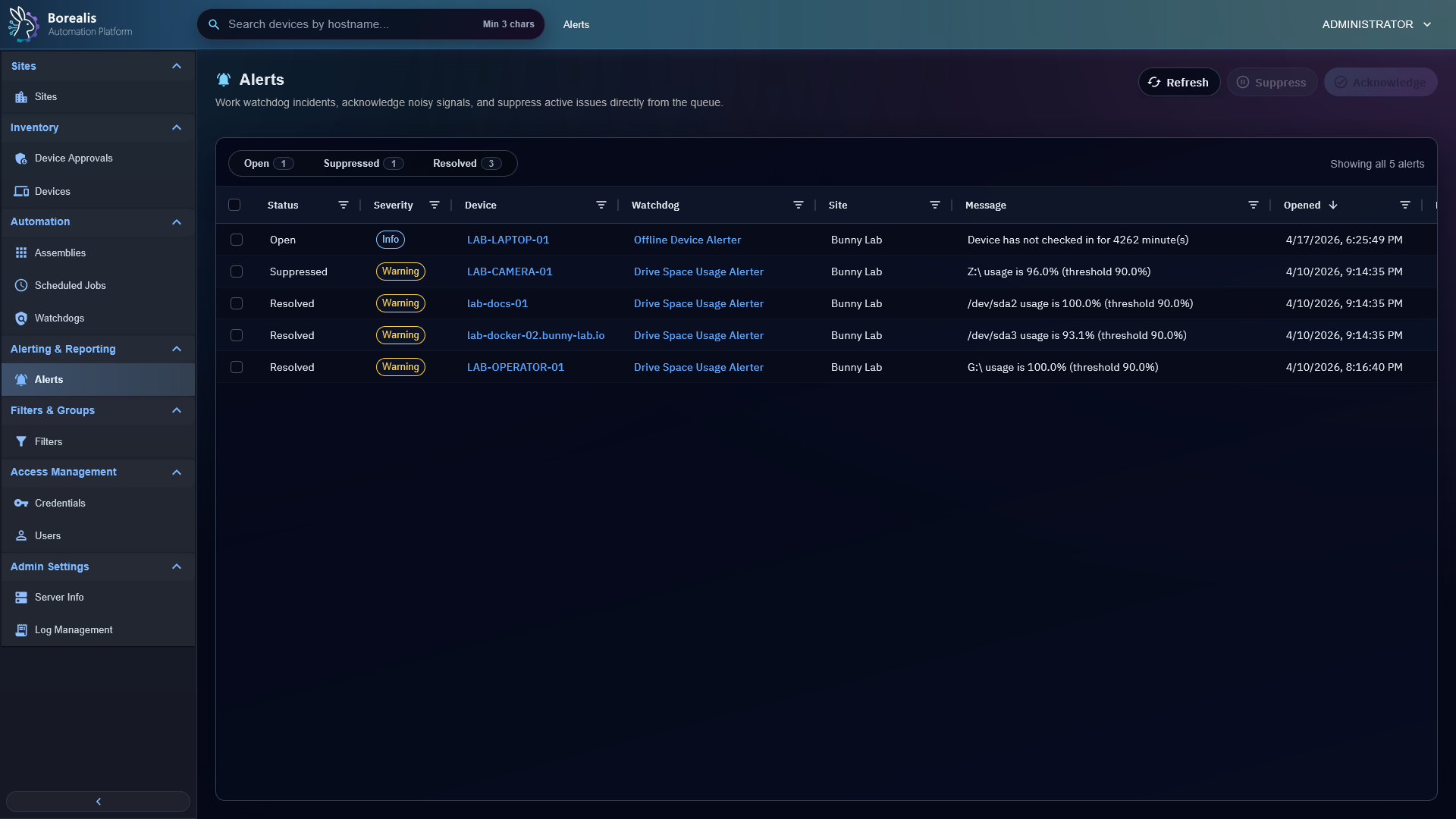
Triage Queue
- Open
Alerting & Reporting > Alerts. - Use status pills for
Open,Suppressed, orResolved. - Use grid filters for severity, site, device, watchdog, message, and timestamps.
- Open device hostname or watchdog name links when deeper context is needed.
Clicking the same status pill again clears that filter back to all alerts.
Incident States
Open: watchdog condition is active.Acknowledged: operator reviewed incident and recorded ownership.Suppressed: operator muted current incident without marking condition fixed.Resolved: condition cleared, policy disabled/archived, target disappeared, or telemetry became stale long enough to auto-resolve.
Suppressing alerts requires a reason. If the reason prompt is cancelled or left blank, Borealis leaves the alert open and does not change incident state.
Offline-only incidents are purged when the device checks back in.
Device-Level Alerts
Device Summary has a Watchdogs tab for active incidents, effective watchdog assignments, and device-level overrides. Use it when one device needs local context or a one-device suppression.
Device-level suppressions also require a reason so other operators can tell why the shared watchdog policy was muted for one endpoint.
Detailed Codex Breakdown
API endpoints
GET /api/watchdogs/incidents- list incidents and queue counts.POST /api/watchdogs/incidents/<incident_id>/acknowledge- acknowledge open incident.POST /api/watchdogs/incidents/<incident_id>/state- move incident between open and suppressed.GET /api/devices/<device_id>/watchdogs- device watchdog view.POST /api/devices/<device_id>/watchdogs/overrides- device override.
Related documentation
Source map
- Alerts UI:
Data/Engine/Containers/webui-frontend/data/web-interface/src/Alerting/Active_Alerts.jsx - Device Watchdogs UI:
Data/Engine/Containers/webui-frontend/data/web-interface/src/Devices/Tabs/Device_Watchdogs.jsx - Watchdog runtime:
Data/Engine/Containers/api-backend/cmd/api-backend/watchdogs_runtime.go
Runtime behavior
- Queue-level suppression is an incident state transition.
- Queue-level suppression and device-level watchdog override suppression require non-empty
reasonvalues. - Device-level suppressions live separately in
watchdog_device_overrides. - Incident rows include watchdog, device, site, severity, title, sampled data, acknowledgement metadata, and timestamps.